Tuesday, February 14, 2012

NO COLORING PAGES, How to Create Light Table and Misc. Ideas for preschoolers and toddlers!


Are you fostering THINKERS and CREATORS instead of just COLORERS???
  • Coloring sheets actually prevent children from being creative thinkers and creators
  • Coloring pages are one sided. There is a picture of one specific thing that does not leave room for imagination and independent ideas.
  • Coloring pages leave little room for choices aside from maybe choosing which colors to use.
  • Coloring pages for this age group are not appropriate as coloring inside the lines requires that the child's fine motor skills be developed beyond their age
  • If you look at the artwork you have hanging on your walls or bulletin boards, do all of the projects look the same???  If so, then how can change that to be able to evaluate children's progress??
Try this exercise in your next staff meeting: 

Print off a coloring page from google images and use your NON-DOMINANT HAND to color in between the lines. 

How did you feel?  Did you get frustrated at all?
This is an example of how it can be limiting and frustrating for a child to color in between the lines. 

So the next time you think about making a photocopy of an image for the children to "color in" or "decorate" as an easy "project", instead, try putting out all kinds of materials, or just markers and blank paper and let them make up their own art!! Children will learn to stay between the lines when they are 16 and learning to drive! <!--[if !vml]-->http://cdn-cf.aol.com/se/smi/2b00003233/04<!--[endif]-->
  :-)

For more info: try this book!
Young at Art by Susan Striker
From the creator of the best-selling Anti-Coloring Book series with more than 600,000 copies sold, a new parenting guide to encouraging creativity in preschool-age children

Young at Art is the first and only comprehensive book for the general audience about the nature, value and impact of art on very young children. Directed towards parents and educators of one to five year olds, Susan Striker explains why children's art is not a frill, but the very foundation upon which all later fundamental skills are built. She drives home the idea that encouraging children's artistic growth will have beneficial effects on all other aspects of their emotional and intellectual development.

At the core of this practical guide is the understanding that art is an important tool in teaching young children crucial concepts related to self-expression, reading and writing. As opposed to more structured exercises, such as coloring on dittos and underlining pictures in workbooks, Striker stresses that scribbling and free drawing experiments are the most important art activities a child can engage in; they better prepare children to read independently as they grow.

Young at Art provides descriptions for age-appropriate art activities, tips for carrying them out safely, and helps parents recognize what a child's art work should look like at each stage of development. With Young at Art, parents will develop realistic expectations of their children's work, learn how to speak to their children about their art, and facilitate skills well beyond their creativity that will benefit children.


IDEAS DE LA SEMANA


Science: Make your own LIGHT TABLE!!

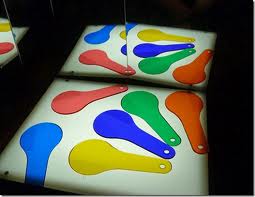
Drill several holes in the sides of an oversize clear plastic storage container, making sure that one hole is large enough for the plug to pass through.  (The smaller holes are for ventilation.)  Put strings of white holiday lights inside the container and pull the plug through the largest hole.  After placing the lid on the container, flip the container over and plug in the lights.  Place the resulting light table in a center along with colorful translucent props. 

OR...instead of drilling holes in the box, purchase the battery operated BUTTON LIGHTS.  If you need to diffuse the light, try taping parchment paper to the top of the lid. 

Translucent Prop ideas:

colorful cups

baggies of colored water in primary colors to have fun mixing colors
Colorful transparent tiles
Colored flat marbles and clear tubes
Colored paddles
Colored ice cubes to build


Science: Magnet Mystery
Hide a variety of metal objects in your sand table, such as washers, binder clips, and jar lids. Provide access to a large magnet. A child moves the magnet through the sand and pulls out the hidden items. What a fun treasure hunt for your little metal detectors!


Math:Memory Puzzles
Try enlarging photos you've taken of class events, such as field trips or parties or anything else! Glue the photos to tagboard and then puzzle-cut each photo and place it in a separate resealable plastic bag. Have the kids assemble the pictures and review the fun things you did throughout the year.


Literacy: Wetter Letters!

Teach youngsters the letters in their names by adding die-cut craft foam letters to your water table! Help a child find the letters that spell his name; then encourage him to stick the wet letters to a side of the water table.


Math:Totally Tubular
Teach children to order by size using cardboard tubes cut into different lengths.  Place the tube pieces at a center and the child stands the pieces in a row from smallest to largest or largest to smallest!

Math:  So Many Socks!
Gather a supply of clean, adult-size tub socks.  Place the socks in a basket.  Gather youngsters in a circle and invite a volunteer to sit in the center of the circle with the basket.  At your signal, have the child pull on as many socks as she can, one over the other, on the same foot.  After a designated amount of time, have her stop,. Then encourage her to remove ethe socks from her foot one at a time as the class counts
aloud. 


Marble Painting Made Easy for TODDLERS!!
This marble painting method is terrific for toddlers!  Tape construction paper to the bottom inside of a large paper bag, spoon paint-covered marbles into the bag, and tape or staple the bag closed.  Have the child grasp the bag and jump and dance around.  'When he is finished, open the bag to remove the finished painting.  When you are done, toss the bag away. 


Have fun at your Multicultural Fiesta manana!!

Jacie

Jacie Feinberg, Education Director
Pine Village Preschool

214 Lincoln Street Suite 112
Allston, MA 02135
www.MyBilingualPreschool.com
781-710-2348 (cell)


<!--[if !supportLineBreakNewLine]-->
<!--[endif]-->

Books in Spanish, Playdough Recipes and El Juegos de las Galletas!!


Feliz viernes a todos!!

Leyendo libros todos los dias en espanol es parte de nuestros dias normales.  Leemos en grupos grandes, en grupitos pequenos y 1:1.  Yo se que siempre estamos buscando mas libros en español, asi que, queria compartir algunas ideas para aumentar sus bibliotecas!

                                                                                 
  1. Book Fairs - Hay muchas companias que venden libros en espanol, y cuando los padres los compran, te dan libros gratis!!  Scholastic Books quizas es una de las empresas mas conocidas, pero tambien Usbourne Books y Barefoot Books ofrecen "Book Fairs".  Check it out!
  2. La Biblioteca - Uds. sabian que pueden hacer un pedido de libros de otras bibliotecas?  A veces toma unas semanas, asi que cuando estan planeando el proximo mes, busca los libros con unas semanas de anticipacion.
  3. Eventos - Unas escuelas hicieron un "Book Exchange".  Pusieron todos los libros en ingles en cajas en unas mesas, y si los padres querian llevar unos libros, tenian que comprar y donar un libro en cambio por el libro en ingles!    O pueden hacer un "fundraiser" como un Silent Auction, School Cookbook para vender o otro evento!  Usan el dinero que ganan para comprar mas libros en espanol! Otra maestra recomendo hacer un evento de cuentos para los padres y su "entrada" seria un libro en espanol.  O quizas pueden hacer un EXCHANGE con una escuelita en otro pais que quiere aprender ingles?? Sean creativos!!  Las ideas son infinitas!
  4. Birthday Books - Pueden comenzar un programa en las escuelas donde piden que los padres donen un libro en espanol a la escuela para el cumpleanos de su hijo.  Pueden poner un PVP Sticker con el nombre y la foto del nino en el libro para aumentar sus bibliotecas!  Que orgullo para el nino y la familia ser parte de Pine Village para siempre!
  5. Comprando Libros Nuevos Cada Mes - Cada escuela tiene dinero cada mes para comprar materiales, asi que pueden usar una parte del dinero para comprar libros online (www.amazon.com, www.barnesandnoble.com, www.spanish-bookworld.com), o en tiendas de libros usados, o librerias!  "Used Books Superstore" tiene libros en espanol, "New England Mobile Book Fair" tambien!  Estoy segura que uds. tienen sus librerias favoritas!  Poco a poco, van a crecer sus bibliotecas!
  6. Ebooks Online- Hay varios "websites" en lo que pueden encontrar libros en espanol GRATIS!  The International Children's Digital Library tiene muchos libros en espanol que pueden leer.  http://en.childrenslibrary.org/. Another EXCELLENT resource for FREE EBOOKS is through www.SpanishPlayground.net.  It will read the book out loud to the class just like a Book on CD. 
  7. Print your own books or make your own!:  Here are a few to get you started!!Un Elefante Se Balanceaba http://www.nellieedge.com/pdf/littleBooks/unelephante.pdf                                       Yo Tengo Un Gato: http://www.nellieedge.com/pdf/littleBooks/yotengo.pdf                                   De Colores http://www.nellieedge.com/pdf/littleBooks/decolores.pdf  Here's the link to show you how to fold them:  http://www.nellieedge.com/pdf/foldlittlebook.pdf   Hay muchas maneras de hacer "Class Books" y es importante hacerlos y leerlos frecuentemente!
  8. Si tienen mas ideas, favor de mandarmelas! 

--------------------------------------------------------------------------------------------------------------------------------------------
                                                            

Hay muchisimos beneficios para el desarollo del nino cuando estan usando Plastilina/Playdough.  Aqui comparto algunos de ellos:
  • It helps to gain control over hand and arm movements which improves coordination
  • Modeling and using cutters & rollers is great for muscle development
  • Play dough is a natural outlet through which children can express their emotions
  • Cooperative play and dramatic play can be seen when children use play dough
  • Discussing what has been made helps build communication skills and develops imagination
  • Dividing it up can be used to help children learn about numbers and counting
  • Playing with dough with others helps children understand the importance of sharing
  • Receiving praise and compliments for their “creation” helps children develop their self-esteem and confidence
  • Play dough can be used as therapy for special-needs children
Aqui estan algunas de mis recetas favoritas!   Es facil hacer plastelina para tu grupo! Be sure to store it in an AIR TIGHT container or plastic bag!
 
Traditional Play Dough
  • 1 cup flour
  • 1 cup warm water
  • 2 teaspoons cream of tartar
  • 1 teaspoon oil
  • 1/4 cup salt
  • food coloring
Mix all ingredients, adding food coloring last. Stir over medium heat until smooth. Remove from pan and knead until blended smooth. Place in plastic bag or airtight container when cooled. Will last for a long time.
Kool-Aid® Play Dough
  • 1 cup flour
  • 1 tablespoon vegetable oil
  • 1 package unsweetened Kool-Aid
  • 1/4 cup salt
  • 2 tablespoons cream of tartar
  • 1 cup water
Mix flour, salt, cream of tartar and Kool-Aid® in a medium pot. Add water and oil. Stir over medium heat 3 to 5 minutes. When mixture forms a ball in pot, remove. Knead until smooth. Put in a plastic bag and refrigerate.


Bouncy Play Dough

  • 2 cups baking soda
  • 1 1/2 cups water
  • 1 cup cornstarch
Place ingredients in bowl and mix with a fork.  Place mixture in saucepan and bring to boiling on medium heat. Cook stirring constantly with a spoon until thick.  Let cool.

Sean creativas con los materiales que les proveen con la plastelina!
  • birthday candles
  • bottle caps
  • milk jug caps
  • cookie cutters
  • feathers
  • garlic press
  • large buttons or other objects that can be pressed into it to make interesting designs
  • leaves
  • pebbles
  • plastic knives, spoons, forks
  • plastic toy people and animals
  • rolling pin or bottle
  • straws
  • tea strainer
  • string or shoelaces
--------------------------------------------------------------------------------------------------------------------------------------------

Juego de la Semana:

El Juego de Las Galletas
En este juego pretendemos que los niños son galletas y les echamos cosas ricas como sprinkles, chocolate, fresa, m&m, etc. y todo lo que queramos.  Los ninos pueden usar su vocabulario en espanol para escojer los ingredientes.  Pueden jugar este juego en el parque, en sus playgrounds, o si tienen un espacio adentro para correr!  Siempre hay una oportunidad de hablar espanol con los ninos!!  Que se divierten!
 1.)  Diles a los ninos que se pongan en una fila en la cerca afuera (o a la pared).  Este es "el horno."
2.)  Empieza a echarles unos ingredientes muy ricos (i.e. azucar verde) y cierra la puerta del horno.
3.)  Mientras "cocinas" las galletas, baila y canta y chequea el reloj para asegurar que estan listas.
4.)  Abre el horno y los ninos salen corriendo, huyundo de la maestra. 
5.)  Repite el proceso hasta que se cansen los ninos (y te canses tu!!) 


Jacie

Jacie Feinberg, Education Director
Pine Village Preschool

214 Lincoln Street Suite 112
Allston, MA 02135
www.MyBilingualPreschool.com
781-710-2348 (cell)


Anti Bias Curriculum


Anti-Bias Curriculum

I had the privilege of going to an Anti-Bias Curriculum workshop this week at Lesley University, and I wanted to share just a sampling of the ideas I gathered for inspiration!  Even though we may be doing our "All Around The World" unit this month, it is a good time to reflect to ensure that you are talking about these things all year round

Please use this checklist to reflect on  your own classroom environment. http://www.adl.org/education/anti-bias.pdf


LITERACY
Take a look at your classroom library?  Do you have books that represent all cultures, family dynamics, abilities and races?   If not, check out the library or AMAZON.com!  Here are a few to get you started!

Whoever You Are   The Colors Of Us   The Crayon Box That Talked     I Love My Hair
By Mem Fox                  By Karen Katz                    By Shane Derolf         By Natasha Anastasia Tarpley

Mommy, Mama and Me     A Tale of Two Mommies   Daddy Papa and Me                                       
By Lesléa Newman           By Vanita Oelschlager                  By Leslea Newman

No Fair To Tigers/No Es Justo  Play Lady/La Senora Juguetona  Best Best Colors/Los Mejores Colores   ALL By Eric Hoffman


Egg Activity
Materials: one raw brown egg, one raw white egg, bowl, white construction paper, colored chart paper (your choice), glue, scissors
In advance copy egg shapes (ovals) on the white construction paper, one for each child. Prepare a class graph on the colored chart paper with two columns, one titled “Same” and the other “Different”.
Gather the students in a circle and examine the eggs; compare and contrast them. Next, ask the students if they think the eggs are the same or different inside. Ask them why they answered the way they did (i.e. “why do you think the brown egg has brown ‘stuff’ inside?”).
Next, have the students each cut out one paper egg and place it on the graph in the column of their choice.
Finally, gather the students in the circle again and crack the eggs into the bowl. Pass the bowl around so the students can see the yolks are exactly the same. Ask the students the significance of the outcome and how it relates to skin color (i.e. “we are all the same on the inside”)

Gift Bag Activity
Materials: one plain brown lunch bag, one plain solid colored gift bag- not shiny or fancy, and one really fancy gift bag with a pretty design and lots of “glitz” and tissue paper sticking out the top- the works. You will also need 3 of the same type of item, like 3 blocks or 3 boxes of crayons- your choice.
Place one of the 3 items of your choice into each bag and display in front of the class. Have a class discussion about which bag the students would like to receive and why. Next, open each bag one at a time in front of the class. The students will see that all 3 bags, although very different on the outside all contained the very same thing inside. This can lead to a great discussion about how people are all different on the outside, but same on the inside.

Yo Soy Unico - Matching Game
 Take photographs of each child's eyes, hair and face in your classroom.  Laminate so you have a new Matching Game to do during Small Group time. 

Block Area -
Tape photographs of your children onto your wooden blocks. Children can then re-enact family structures or whatever else inspires them!

Differing abilities:
  • Have the children try drawing a picture with a blindfold on, or with their non-dominant hand. 
  • Place large gloves in the sensory area and have them try to put together blocks or play with toys wearing the gloves.
  • Make a sensory bag and have them feel and guess what items are in the bag without seeing it. 
  • Be sure to include "people" toys representing various cultures and abilities mixed in with your other "people" toys. 
Pre-K History Lesson on Rosa Parks- (with Martin Luther King Jr. Day around the corner...)
Using a toy bus or a cardboard one that you make, re-enact the story of Rosa Parks refusing to move to the back of the bus.  When Martin Luther King Jr. heard about this, he then initiated a Boycott on the Montgomery, Alabama buses.  After the boycott, then the Supreme Court passed a law stating that segregation on the buses was unconstitutional.  This initiated the Civil Rights movement of the 1960's.  Encourage the children to act it out with chairs as well and talk about how it would make them feel. 

I Have a Dream Cloud
Materials: crayons, white construction paper, scissors, glue
Discuss with your class that Dr. King had a dream; his dream was to make the world a better place. The song of the same title above is very helpful for this activity. Discuss with your class what this phrase means and brainstorm ways that they could help make the world a better place. Next, have your students draw on the white construction paper with crayons and illustrate a way that they could make the world a better place. Cut these masterpieces out with scissors in a cloud shape and make a wall display or you can hang them from the ceiling so the clouds will appear to be floating above you.


What is Discrimination?
Materials: Signs with rules that will be enforced in each classroom area.
Description: Teach young children about discrimination by hanging signs or post signs in each center with a picture of, for example, sneakers with a circle around it and a slash through it. This means that for the next hour, no one with sneakers on may play in that center. Use your imagination, you can do girls, boys, long hair, short hair etc.  Discuss feelings during circle time.
Skin-Color Match-Ups

Set out a number of nylon knee-high stockings in various shades, tan, black, white, pink, yellow, and red. Encourage children to try them on their hands and arms or their legs and feet. Ask questions to help the children increase their awareness of skin color. For example, "Can you find a stocking that is the same color as your skin?" Or "What color is that stocking you have on your arm?" Ask the children to "Try the _________ stocking. Is it lighter or darker than your own skin?" Tell the children no one's skin color is really white, pink, yellow, or red. Emphasize that skin-color differences are interesting and desirable.

Hair
Ask parents to give you a tiny bit of hair from each child. If parents cannot do this, use photographs of different hairstyles and hair-care products for the children to use, explore, and talk about. If parents do give you the hair, paste the hair from each child on a 3" x 5" index card, put them in a box, and ask the children to identify each bit of hair. Talk about how hair has texture and curl. For instance, some people have fine hair while others have coarse hair. Some people have straight hair, and others have curly hair. Talk about how people have different hair colors and lengths. Take a photo of each child's face and make a collage of different hairstyles.

Family Finger Puppets
Using Plaster of Paris and casting tape, (or use papier mache = paper and glue/water mixture, or just paper) wrap each child's finger with the tape and let it dry.  Once it has hardened, have the children decorate their family...maybe they have two mommies, maybe an intergenerational family, or perhaps two sets of families where they live with mommy sometimes and daddy sometimes.  Use the puppets in your puppet theater for acting out important stories that you write together as a class!  It's important to recognize that everyone has their own special family and it's okay!

If you are looking for more information about Anti-Bias Curriculum, here is a good, short article to get started!
http://www.ericdigests.org/1992-1/early.htm
Happy Long Weekend!
-Jacie

Jacie Feinberg, Education Director
Pine Village Preschool

214 Lincoln Street Suite 112
Allston, MA 02135
www.MyBilingualPreschool.com
781-710-2348 (cell)